
Reviewed · 2-DAY EXPERIENCES
2 Days In Giza And Cairo. (Including lunch)
Two days in Egypt can feel unreal. I like how this tour spreads the big hits across Giza and Cairo with a private guide, so you are not trying to read history at highway speed. You get front-door hotel pickup and drop-off, and you start early enough to make the most of the daylight.
What I really love is the value built into the package. All admission tickets are included, and you also get two included lunches, which means you can spend less time hunting for food and more time absorbing what you are actually seeing.
One possible drawback to keep in mind: the days are full and time-boxed. If you want long, slow wandering with zero structure, you might feel squeezed, especially around the most popular spots like Giza and the museum.
In This Review
- Key things to know before you go
- Two Days That Let You See Cairo Without Getting Dizzy
- Day 1 on the Giza Plateau: Pyramids, Valley Temple, and the Sphinx
- Saqqara’s Step Pyramid of Djoser: The World’s Oldest Major Stone Structure
- Memphis and Sakkara: Adding the Old Kingdom’s Capital Context
- Dahshur: Bent and Red Pyramids and the Logic Behind the Design
- Day 2 at the Egyptian Museum: King Tut and the Museum as a Story
- Cairo Citadel and Muhammad Ali Mosque: One Stop That Covers Centuries
- Khan Al-Khalili Market Time: Where You Can Finally Browse
- What You’re Really Paying For: Value at $300 Per Person
- Guides, Pacing, and How to Avoid the Only Real Complaint
- Comfort and Practical Stuff You Should Plan For
- Who This Tour Works Best For
- Should You Book This 2-Day Giza and Cairo Tour?
- FAQ
- What’s the start time for this tour?
- Does the tour include hotel pickup and drop-off?
- Are admission tickets included?
- Are meals included?
- What sites are covered over the two days?
- Do I need to pay for tickets separately?
- What’s not included in the price?
Key things to know before you go
- Private guide explanations that help you connect pyramids, Memphis, King Tut, and Cairo’s mosques instead of just snapping photos
- Hotel pickup and drop-off so you can skip the stress of figuring out transport on your own
- Admission tickets plus two lunches built into the schedule for less hassle and better predictability
- Air-conditioned vehicle for comfort moving between far-flung sites across Cairo and Giza
- A balanced mix of ancient and Islamic Cairo, including Khan Al-Khalili market time
- Two-day pacing that’s calmer than trying to cram everything into one day
Two Days That Let You See Cairo Without Getting Dizzy
Cairo and Giza are heavy on “wow” moments. The problem with many rushed plans is that you spend most of your energy on logistics and context, not on actually understanding what you are standing in front of.
Here, you get a private, full-day rhythm over two consecutive days. That matters because the sites are not similar. You go from pyramid geometry and royal funerary culture, to Saqqara’s earliest major stone structure, to Memphis as the Old Kingdom power center, and then into Cairo’s museum galleries and Islamic landmarks.
Also, the private format makes it easier to ask questions and adjust your time at the most interesting parts. In the best-case scenario, you finish feeling like you had a guided conversation with ancient Egypt, not a checklist.
Other Cairo options on the table
- Cairo: Pyramids & Great Sphinx Private Tour with Camel Ride
★ 4.9 · 6,335 reviews - Tour to Giza Pyramids and The Egyptian Museum
★ 5.0 · 6,016 reviews - VIP All inclusive Best of the best Giza Pyramids,Sakkara,Memphis
★ 5.0 · 3,164 reviews
Day 1 on the Giza Plateau: Pyramids, Valley Temple, and the Sphinx
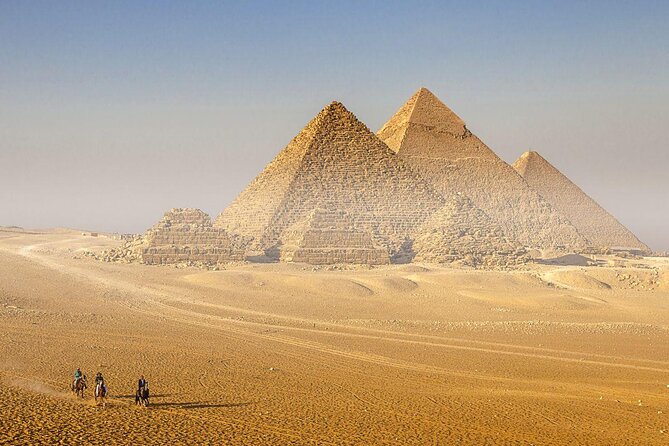
You start at the Pyramids of Giza with a ride in an air-conditioned car, picked up from your hotel. From the plateau area, you get panoramic views and you’ll see the Great Pyramids of Giza, including Cheops (Khufu), Chephren (Khafre), and Mycerinus (Menkaure). You also pass tombs of high officials and relatives of the kings, which helps you understand this was not only about the pyramids, it was about a whole royal landscape.
A big plus is that your guide does more than point. You get explanations that connect the pyramids to the broader religious and political world, then you head toward the Valley Temple and the Great Sphinx. This is the moment most people came for, but it is also the one where having a guide makes your photos more meaningful.
Time check: this stop is about 3 hours, including the key views and walking between highlights. If you love photography, wear shoes you can handle on uneven ground, because you are going to spend real time on your feet.
Saqqara’s Step Pyramid of Djoser: The World’s Oldest Major Stone Structure
After Giza, you drive to Saqqara, home to the Step Pyramid of King Djoser (Zoser). This is one of those stops where you start to see the “why” behind Egypt’s pyramid evolution.
Your guide explains that the Step Pyramid was built in the 3rd Dynasty and credits Imhotep (Imhotep) as the genius architect. You also learn about the use of limestone in the funerary complex, which is a detail that can make the site feel less like a shape and more like a construction breakthrough.
You’ll also see the pyramid of Teti and officials’ mastabas around the area. That turns Saqqara from a single-photo stop into a mini map of Old Kingdom power, with layers of history stacked close together. This section runs about 2 hours, and it’s a great balance after the intensity of Giza.
Memphis and Sakkara: Adding the Old Kingdom’s Capital Context
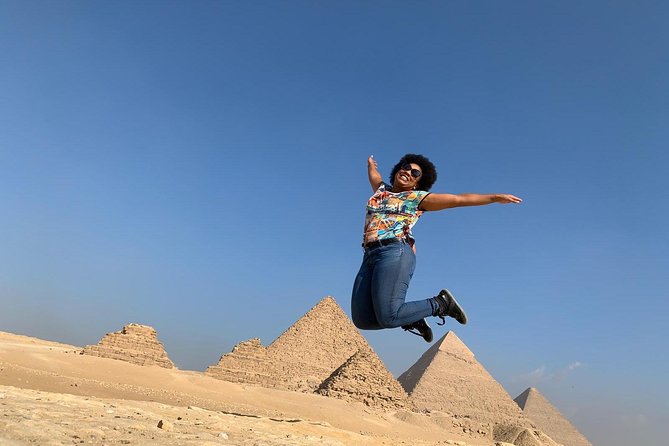
Next you transfer to Memphis, founded by King Menes and remembered as Egypt’s capital during the Old Kingdom. Even if you have only a basic sense of Egyptian history, this stop helps you “place” the pyramids in a real political world.
You’ll see the Statue of Ramses II and the Alabaster Sphinx of Memphis. Seeing those pieces after the pyramids and Saqqara gives your day a clean storyline: you are not just traveling between sites, you are watching Egypt’s power centers shift and repeat.
Then you get lunch at a nice restaurant. The schedule gives you about 1 hour here, which is enough time to eat without losing the thread of the day. I like that lunch is included. In Cairo, that alone can save you time, since you do not have to negotiate where to go.
Also reachable from Cairo:
- From Cairo: Pyramids of Giza, Sphinx, Saqqara & Memphis Tour
★ 4.7 · 3,110 reviews - Cairo 8 Hour Private Tour of Pyramids, Egyptian Museum and Bazaar
★ 5.0 · 2,931 reviews - Cairo: Pyramids, Sakkara & Memphis Tour with Lunch
★ 4.6 · 2,493 reviews - Private ViP all-inclusive Giza Pyramids,Sphinx,Inside Pyramid
★ 5.0 · 2,448 reviews
Dahshur: Bent and Red Pyramids and the Logic Behind the Design
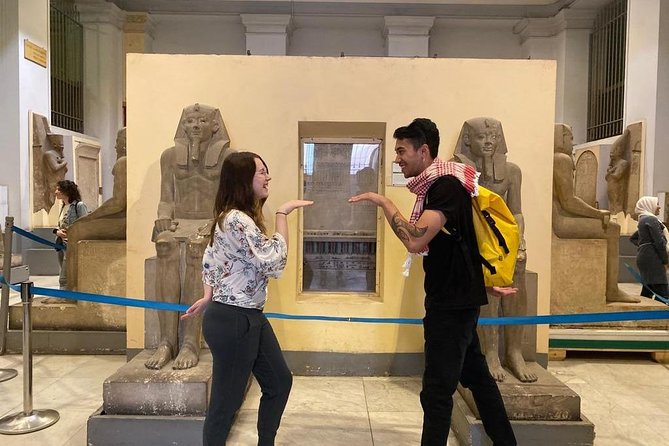
In the afternoon you head to Dahshur, another key area for understanding the progression toward true pyramid design. Here you visit the Bent Pyramid and the Red Pyramid, built for King Snefru, father of Khufu and founder of the 4th Dynasty.
The Bent Pyramid is often described as a “failure attempt,” but what matters for you is that your guide explains it in context. You get the sense of trial, experimentation, and adaptation. That makes Dahshur feel like engineering history, not just more stone monuments.
This portion is about 2 hours, and it ends with your guide dropping you back at your hotel. I like this ending because it gives you a clean reset after a full day of walking and cross-city driving.
Day 2 at the Egyptian Museum: King Tut and the Museum as a Story
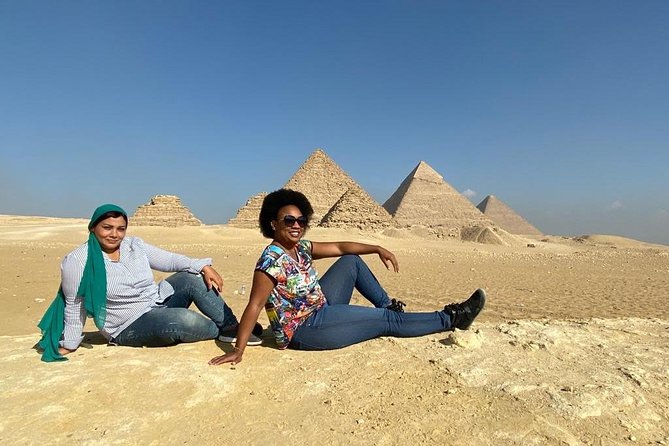
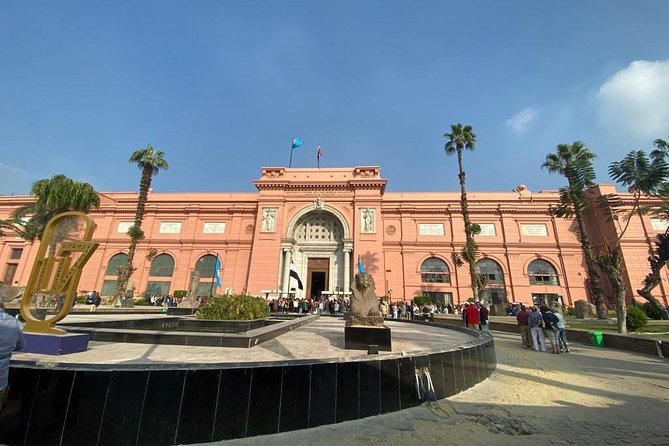
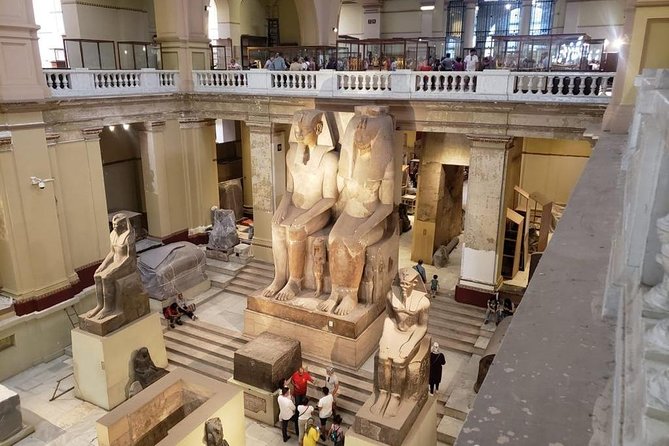
The second day starts back in central Cairo at the Egyptian Museum of Antiquities. This is where many first-time visitors feel like they finally get the human side of the pyramids, because you are looking at objects tied to named people and real royal families.
You spend about 3 hours in the museum, including the collection of King Tutankhamen. The famous golden mask is there, and you also see pieces tied to the princes Yuya and Thuya, remembered as great-grandparents of King Tut. These details matter because they connect the museum objects to the larger family tree of power, not just the most iconic item.
With a private guide, you are less likely to wander aimlessly through rooms full of everything. You get a route through the important sections so you can feel grounded when you look at statues, artifacts, and royal items.
Cairo Citadel and Muhammad Ali Mosque: One Stop That Covers Centuries
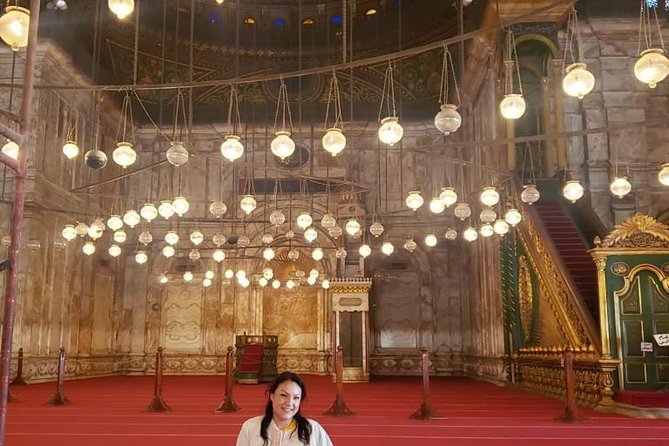
After the museum, you move to the Citadel of Salah El-Din. Built in 1182 AD, it is the kind of place that helps you shift from ancient Egypt to later eras in a single location.
You can also visit the Alabaster Mosque of Mohamed Ali pasha, built in 1848 AD. Your guide explains it was designed by the Turkish architect Youssef Bushnok in an Ottoman style, and that Muhammad Ali wanted it to challenge Ottoman power. Even if architecture is not your main interest, this framing helps you see the mosque as politics made stone.
This stop is about 2 hours, and it pairs well with the museum day before. You get a museum version of history, then a live version of history where people still pray inside a landmark built in the modern era.
Then lunch happens again at a nice restaurant, around 2 hours total for this segment in the schedule. It’s enough time to eat and recharge before the market.
Khan Al-Khalili Market Time: Where You Can Finally Browse
The final major stop is Khan Al-Khalili, the open market in Islamic Cairo. Your guide explains it was built during the days of Mamluk Sultan Barqouq in the 14th century, and it is known as one of the oldest and biggest markets in the Middle East.
This is also where you get some breathing room at the end. You spend about 2 hours here, which gives you time to look around without forcing you to squeeze shopping into transit.
One thing I like about ending at a market is that it is a change of pace from monuments. You get Cairo as a living city, not just a museum or archaeological site. If you want souvenirs, this is the place to plan for them.
You then transfer back to your hotel to close the loop.
What You’re Really Paying For: Value at $300 Per Person
This tour is $300 per person for two full days, with hotel pickup and drop-off, an expert guide, an air-conditioned vehicle, and entry fees to all mentioned sites, plus two lunches.
That price can look high if you only compare it to the cost of tickets. But you are not only buying admission. You are buying the guide’s explanations that make the pyramids, Memphis, and the museum cohere, plus the effort of coordinating transport between Giza, Saqqara, Dahshur, central Cairo, and Khan Al-Khalili.
If you tried to do it on your own, you would likely spend money on private transport anyway, then add the headache of deciding where to go and what to prioritize. Here, the structure is doing that work for you, and you also get the comfort of a vehicle that keeps you out of the sun and off your feet during the drives.
This makes it a strong option if you only have a couple days and you want your time to feel intentional.
Guides, Pacing, and How to Avoid the Only Real Complaint
One recurring theme in feedback is praise for smoothness and strong guiding. Names that came up include Hala, Mo, Haitham, Mohammed, and Ahmed hadida. People also highlight that guides do not just recite dates, they help you read what you are seeing.
Still, there’s one caution worth respecting: a rushed feeling can happen if you want lots of independent wandering. The good news is that this is easy to manage. When your guide finishes explaining a site, ask right away how much time you have for photos and browsing. Use that window instead of waiting until you feel impatient.
Also, treat the included stops like a framework. If you spot something you want to linger over, tell your guide early, not at the last minute. With a private group, there’s often room to adjust within the broader time plan.
Comfort and Practical Stuff You Should Plan For
This is a lot of walking across major archaeological areas and museum galleries, so wear comfortable shoes. Bring a hat and water, especially in Giza and Saqqara. The air-conditioned vehicle helps, but you still need to handle outdoor heat and sun while you are at the sites.
For the museum, keep in mind that it’s still a serious amount of time, about 3 hours. It helps to show up with a basic plan of what you want to see most, so you do not get overwhelmed.
If you are sensitive to long days, this two-day structure still means day 1 and day 2 each feel like a full itinerary. It’s not a half-day “greatest hits” tour.
Who This Tour Works Best For
I think this tour is ideal if:
- You want a private guide to make Cairo and Giza feel understandable, not just impressive
- You value included tickets and lunches to reduce decision fatigue
- You have two days and want a broad mix: pyramids, Memphis, the Egyptian Museum, the Citadel, and Khan Al-Khalili
- You prefer staying together as a group with planned transport rather than mapping it out yourself
It may feel less ideal if you want a slower, more spontaneous schedule with lots of free time at each stop. In that case, you’ll need to be very proactive about asking for time to linger.
Should You Book This 2-Day Giza and Cairo Tour?
Book it if you want a clean, guided path through Giza, Saqqara, Memphis, Dahshur, the Egyptian Museum, the Citadel, and Khan Al-Khalili without spending your holiday in “figure it out” mode. The package is strong on value because admissions and lunches are included, and you get hotel pickup and drop-off plus a guide to connect the dots.
Skip it or reconsider if you hate structured timing and want maximum free roaming. In that case, you might feel impatient even with a private guide.
If you do book, send a message before the tour start with what you care about most, pyramids vs museum vs Islamic Cairo. With guides like Hala, Mo, Mohammed, or Ahmed hadida frequently mentioned for making the experience easy and fun, you’ll be in good hands.
FAQ
What’s the start time for this tour?
The tour starts at 8:00 am.
Does the tour include hotel pickup and drop-off?
Yes. You get front-door pickup and drop-off from any hotel in Cairo.
Are admission tickets included?
Yes. Entry and admission for all mentioned sites are included.
Are meals included?
Yes. The tour includes two lunches during the two days.
What sites are covered over the two days?
You visit the Pyramids of Giza, Saqqara Step Pyramid (Djoser), Memphis, Dahshur (Bent and Red Pyramids), the Egyptian Museum (including King Tutankhamen’s collection), the Cairo Citadel with the Muhammad Ali Mosque, and Khan Al-Khalili.
Do I need to pay for tickets separately?
No. All admission tickets are included, and you also receive a mobile ticket.
What’s not included in the price?
Personal expenses and tipping are not included.
Newly added near Cairo
- Private Day Tour to El Fayoum & Valley of the Whales from Cairo★ 5.0 · 13 reviews
- Full Day Tour Giza Pyramids, Sphinx and Egyptian Museum &Felucca★ 5.0 · 9 reviews
- Private Day Tour Egyptian Museum, Citadel ,Mohamed Ali Mosque and Coptic Cairo★ 5.0 · 34 reviews
- Private Day Tour To Luxor from Cairo by Plane★ 4.5 · 41 reviews
- Grand Egyptian Museum★ 3.5 · 48 reviews
- Private Cairo Day Tour Giza Pyramid, Sphinx, Civilisation Museum★ 5.0 · 19 reviews
- Allinclusive Private Tour Fayoum Oasis & Valley of Wales★ 5.0 · 78 reviews
- Private Day Tour To Luxor from Cairo by Plane,Tours,Sailing Felucca,Camel&Lunch★ 5.0 · 45 reviews
2-Day Experiences, compared.
2-Day Luxor Tour with Hotel, Balloon, & Boat Ride
Read our review →
White & Black Desert tour 2 Days 1 night camping from Cairo.
Read our review →

White & Black desert camping tour 2 Days 1 night From Cairo
Read our review →
2 days cairo and giza attractions plus Gem, private tour
Read our review →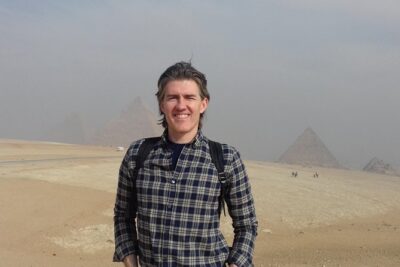
All Inclusive 2-Day Private Tour to All Pyramids and Cairo and 2 evenings
Read our review →
2-Day Top Attractions and Adventures Package in Luxor with Accommodation
Read our review →
2-Day Bahariya & White Desert Private Camp Adventure
Read our review →Browse the lists this tour appears in