
Reviewed · VALLEY OF THE KINGS & WEST BANK TOURS
Private Full Day Tour: Valley of the Kings,Hatshepsut temple&more
One long day, five West Bank stops. This private tour strings together Luxor’s biggest archaeological hits with hotel pickup plus an English-speaking professional guide, so you spend less time figuring things out and more time understanding what you’re seeing. I like that you get a tight route across the Valley of the Kings and Queens, then you keep going into temples and the worker village.
My other favorite part is the practical pacing. You get the key sites, with time allocated for each one (for example, 2 hours in the Valley of the Kings), and bottled water included in the vehicle. A good consideration, though, is that it is a long day, and you will not be visiting the tomb of King Tutankhamun, even though it’s the most famous name in the Valley of the Kings.
In the field, the experience seems to run on good communication and comfort. In feedback tied to this kind of tour, guides such as Mobarak are praised for clear explanations, and drivers like Taha are noted for modern, air-conditioned rides and flexibility on how long you spend at stops.
The schedule also means you get fewer chances to linger. If you love slow museum-style viewing, think of this as a highlights route, not a sit-down, take-your-time day. Also, Colossi of Memnon is brief (15 minutes), and the Valley of the Queens is relatively short (45 minutes), so you may want to bring curiosity, not expectation of deep study at every stop.
In This Review
- Key highlights you will feel right away
- Private West Bank route, why it works as one full day
- Getting there in comfort, then moving with a plan
- Valley of the Kings: 3 tombs, and how to use your 2 hours
- Deir el-Bahari and Queen Hatshepsut: the temple built by a rare pharaoh
- Valley of the Queens: faster timing, strong context
- Medinet Habu, Ramses III’s mortuary temple and ritual space
- Deir el-Medina: meeting the artisans behind the royal tombs
- Colossi of Memnon: the quick stop with big presence
- Price and tickets: getting your value straight before you book
- Who this tour suits best, and who should think twice
- Final call: should you book this West Bank day?
- FAQ
- How long is the private full day tour?
- What sites are included on the West Bank of Luxor?
- Are admission tickets included?
- Do I get hotel pickup and drop-off?
- Is this tour private?
- Do I receive a mobile ticket, and is water provided?
- What is the cancellation policy for a full refund?
Key highlights you will feel right away
- Hotel pickup and return in a private, air-conditioned vehicle
- Valley of the Kings with 3 tomb visits, excluding Tutankhamun
- Queen Hatshepsut at Deir el-Bahari, built by a rare female pharaoh
- Medinet Habu (Ramses III) as a major funerary temple complex
- Deir el-Medina, seeing the artisans behind the royal tombs
- Colossi of Memnon, a fast iconic stop with massive scale
Private West Bank route, why it works as one full day
Luxor’s West Bank can feel like a jigsaw puzzle if you try to tackle it on your own. This tour turns it into a clean route: tombs first, then temples, then the worker village, then the Colossi. You end up with a fuller picture of how Egyptians moved from royal power in life to royal memory after death.
I like that the day is built around contrasts. You start with royal burials in the Valley of the Kings, then shift to the Valley of the Queens for royal women and family members. After that, you move from tombs to funerary temples and ritual spaces, and then to the people who actually made it all happen at Deir el-Medina.
The value here is not just that it covers several famous sites. It’s that you get context while you walk. A good guide can connect the dots between a queen’s temple, a pharaoh’s mortuary cult, and the tomb builders’ daily lives, so the West Bank stops feel linked instead of random.
More West Bank and Valley of the Kings visits:
- Hurghada: Luxor Valley of the Kings & Tutankhamun Tomb Trip
★ 4.7 · 13,208 reviews - Luxor: Valley of the Kings and Hatshepsut Temple Day Tour
★ 4.4 · 1,404 reviews - Hurghada: Luxor Tour with Valley of Kings, Karnak & Tut Tomb
★ 4.6 · 1,082 reviews
Getting there in comfort, then moving with a plan
This is a private tour with all transfers handled by a private, air-conditioned vehicle. Pickup and return happen from your hotel in Luxor, and there is bottled water on board during the tour. That sounds small, but it matters on a full-day West Bank visit, where you are mostly moving from one site to the next.
Time management is also part of the package. Your itinerary includes specific blocks at each place, like 1 hour 30 minutes at Hatshepsut’s temple and 1 hour at Medinet Habu. In practical terms, that means you are less likely to get stuck waiting around or forced to rush through the important parts.
One more helpful detail: the experience is designed for an English-speaking professional guide. In feedback connected to this tour style, communication is praised, and guides are described as patient while explaining the scenes and details you see in the tombs and temples. If you care about understanding the symbolism instead of just taking photos, that’s a big deal.
Valley of the Kings: 3 tombs, and how to use your 2 hours
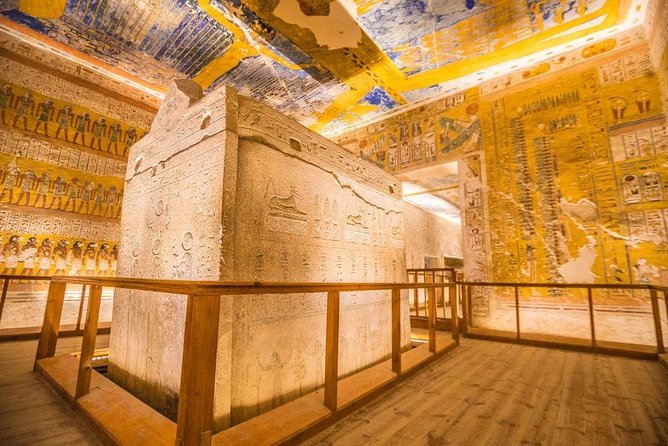
The Valley of the Kings is the headline act on the West Bank, mainly because it contains tombs of Egyptian pharaohs, including the name you hear everywhere, King Tutankhamun. This tour focuses on visiting 3 tombs, with Tutankhamun’s tomb excluded.
That exclusion is important to know up front. If Tutankhamun is your must-see, this specific plan may feel limiting. But if your goal is to see how the burial tradition looks across multiple royal tombs, 3 tombs can be a solid sampler rather than a one-tomb sprint.
Spend your time like this:
- Start with a mindset to compare styles, not just admire craftsmanship.
- When you enter each tomb, focus on how the space is organized and how the artwork is laid out.
- Keep an eye on what feels consistent across the tombs, because that’s often where the real meaning shows up.
The upside of doing this with a guide is that you are not left guessing what you are looking at. The walls are not random decoration, and with explanation, the tomb scenes start to feel like a system.
Deir el-Bahari and Queen Hatshepsut: the temple built by a rare pharaoh
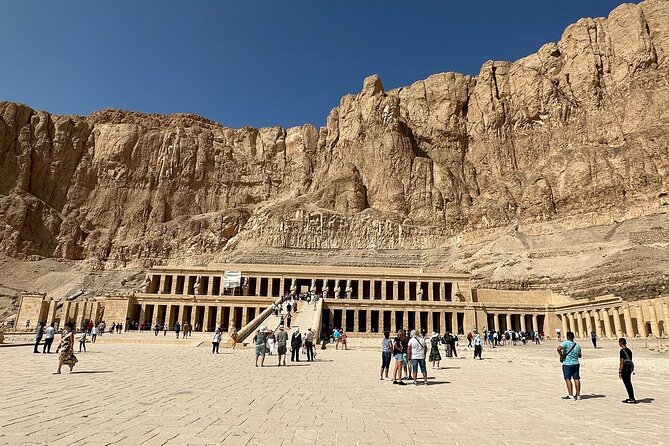
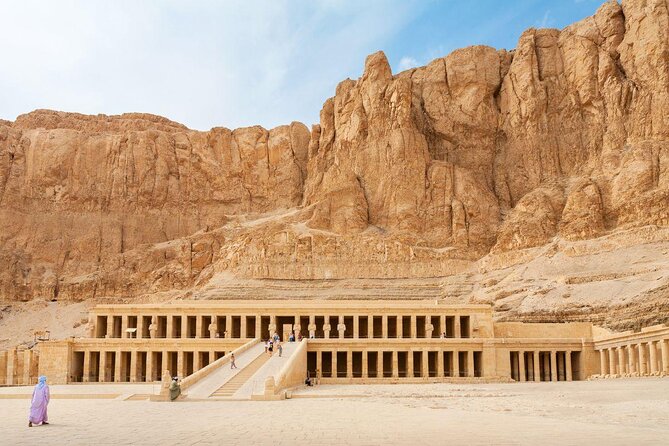
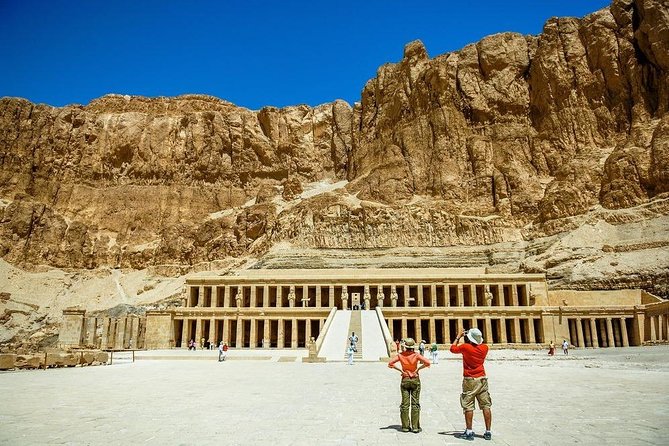
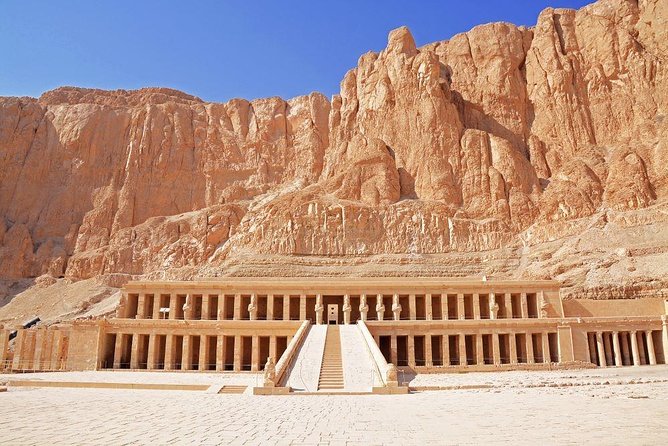
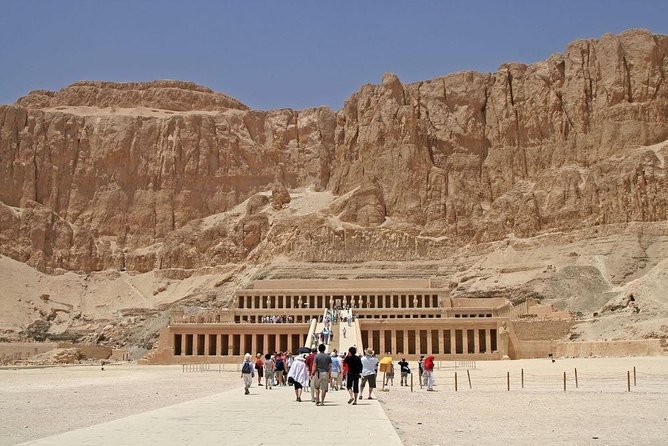
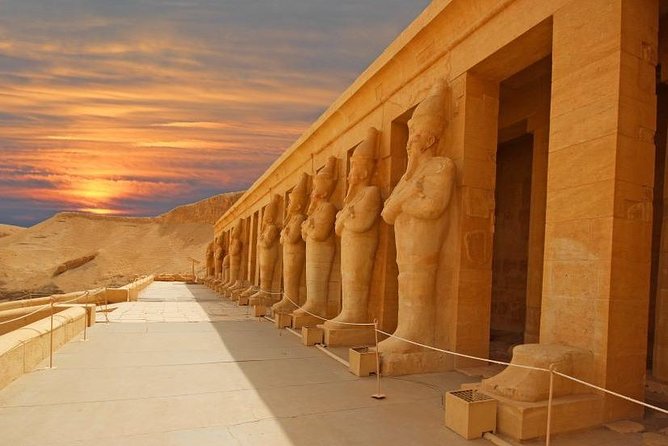
Next up is the Temple of Hatshepsut at Deir el-Bahari. This is where the day becomes more than tomb-and-statue viewing. Hatshepsut was the daughter of Thutmosis I and ruled Egypt for about 20 years during the 18th Dynasty, around 1490 to 1469 B.C. She is also remembered as the only pharaonic woman who reigned ancient Egypt.
That history matters because you can feel it in the temple design. A mortuary temple is not only about worship after death. It’s also political messaging, built to shape how the kingdom remembers a ruler. If you like seeing power expressed in architecture, you will likely enjoy this stop.
You also get a realistic time block here, about 1 hour 30 minutes. That’s enough time to take in the overall layout, then focus on specific details with your guide’s help. You are not rushed to move on before things start clicking.
Other Luxor options on the table
- Luxor Day Trip from Hurghada Small Group & Tutankhamun Tomb
★ 4.8 · 5,366 reviews - Hot Air Balloon Ride in Luxor Egypt with Transfers Included
★ 5.0 · 4,319 reviews - Luxor: Shared Full-Day Tour to Luxor West and East Banks
★ 4.5 · 1,812 reviews - Luxor: Hot Air Balloon Ride over Luxor Relics
★ 4.8 · 1,681 reviews
Valley of the Queens: faster timing, strong context
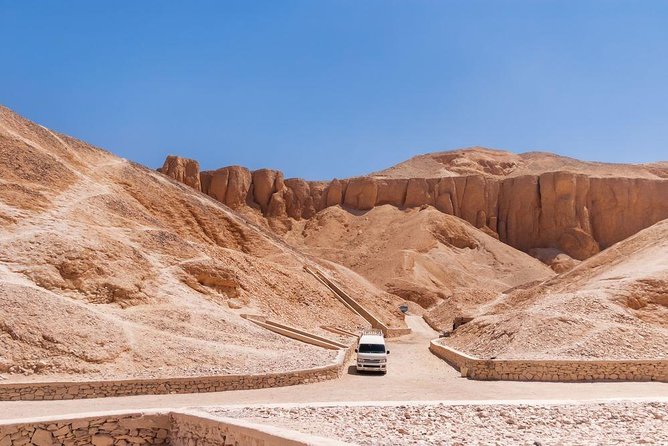
The Valley of the Queens sits opposite the Valley of the Kings on the West Bank. It’s known as Biban el-Harim and served as a burial place during the New Kingdom, roughly 1550 to 1070 BCE. Tombs here were for queens, princesses, and other royal women and family members.
This stop lasts about 45 minutes, with admission included. That’s short, but the payoff is contrast. Seeing women’s burials after seeing the pharaohs’ landscape gives you a wider view of royal life and royal memory, not just the king-shaped version of the story.
There is also a neat naming detail. The modern label is Valley of the Queens, while the ancient Egyptians referred to the area as Ta-Set-Neferu, meaning The Place of Beauty. Even if you only catch the name as a quick fact, it helps you see the site with the right frame of mind.
Medinet Habu, Ramses III’s mortuary temple and ritual space
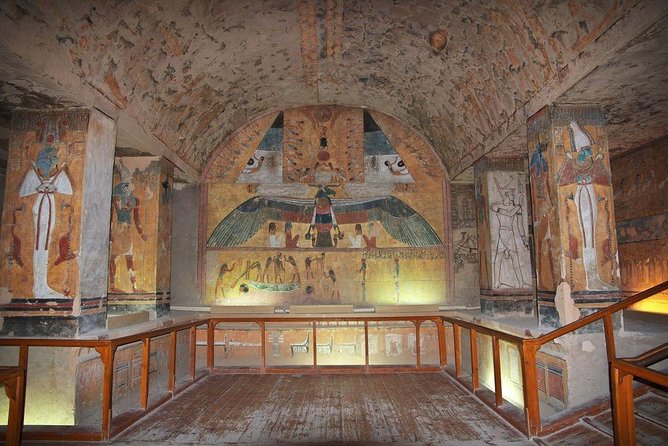
Then you move to the Mortuary temple of Ramses III, also known as Medinet Habu. Ramses III ruled roughly from 1186 to 1155 BCE, and the temple was built as a funerary temple to honor him after death. It also functioned as a site for the pharaoh’s mortuary cult, meaning rituals and offerings linked to the ongoing worship of the dead king.
This is one of those stops where your brain shifts gears. Instead of tomb interior artwork, you’re looking at temple spaces that were meant for ritual activity. The complex is large, with an area cited around 24,000 square meters, so even with a 1-hour visit, you get a sense of scale.
If you’re the type who likes to understand why a site looks the way it does, this is a good match. You can think of the tomb and temple as two parts of one system, burial below and commemoration above.
Deir el-Medina: meeting the artisans behind the royal tombs
Deir el-Medina, the Valley of the Artisans, is a change of pace in a very good way. It was an ancient Egyptian village that housed craftsmen and workers who built and decorated the royal tombs in the Valley of the Kings and Valley of the Queens.
The village was established in the New Kingdom period and was inhabited roughly from the 15th century BCE to the 11th century BCE. That gives you a timeline, but the stronger benefit is perspective. Instead of only focusing on kings and queens, you get people who carved, painted, and sculpted, and who lived with the daily pressure of creating the tombs that would outlast them.
This stop is about 1 hour. That’s usually enough time to absorb the basic layout and hear the role this community played. If you enjoy human-scale stories, this is likely the stop that makes the rest feel more real.
Colossi of Memnon: the quick stop with big presence
You end with the Colossi of Memnon. These are a pair of massive stone statues on the West Bank, depicting Pharaoh Amenhotep III from the 18th Dynasty. The statues were originally at the entrance of Amenhotep III’s mortuary temple, which has since been mostly destroyed.
The sheer size is hard to ignore: each statue is about 18 meters tall, and the weight is cited around 720 tons. The statues portray Amenhotep III seated, hands resting on his knees. There were originally more color details, but much of it has faded over time.
This part of the itinerary is brief, about 15 minutes, and admission here is free. That can feel too short if you want to linger for photos, but it also keeps the day from dragging. Think of it as a visual punctuation mark, something huge and symbolic to close on.
Price and tickets: getting your value straight before you book
The listed price is $11.28 per person, which is impressively low compared with how many stops you are getting. Still, I’d treat that number as the starting point and confirm what your final total includes.
Here’s the key detail: tickets are included for the mentioned sites if you choose the all-inclusive option. Colossi of Memnon is described as free admission, but the other stops list admission tickets as included. So your real value comes down to whether you select the ticket-inclusive choice.
Also consider tipping. Tipping is listed as not included, so plan for that on top of the tour price. And if you are thinking about airport pickup, that is also listed as an extra charge. For most people staying in Luxor, hotel pickup and return are included.
If you are comparing tours, don’t just compare the headline price. Compare what you get for the duration, plus whether the major site admissions are bundled.
Who this tour suits best, and who should think twice
This is a great fit if you want one structured day that covers the most famous West Bank sites without the stress of planning transport between them. It’s also a good choice if you like guided context, because the route is built around tombs, temples, and Deir el-Medina, where explanation can really change your experience.
You might think twice if you are fixated on only one absolute highlight, like Tutankhamun’s tomb. This plan visits 3 tombs in the Valley of the Kings and excludes Tutankhamun’s tomb. It’s also better for people who can handle a 7 to 9 hour day, since the itinerary is full and time blocks are tight.
It should work well for most travelers. The experience notes that most travelers can participate, and it’s near public transportation, but it is also described as a private tour, meaning only your group participates.
Final call: should you book this West Bank day?
Book it if you want a guided, efficient West Bank overview that hits the main tomb valleys, the Queen Hatshepsut temple, a major Ramses III funerary temple, Deir el-Medina, and the Colossi of Memnon in one go. The combination of private air-conditioned transport, hotel pickup, bottled water, and an English-speaking guide is a strong match for people who value convenience and clear explanations.
I would book it even more confidently if you select the option that includes admissions, since ticket coverage is tied to your all-inclusive choice. And if you care about Tutankhamun specifically, double-check what tombs are included in your package before you commit.
If your idea of a great day is learning as you walk, this route is a smart, practical way to see Luxor’s West Bank in a single long block of time.
FAQ
How long is the private full day tour?
The tour duration is listed as approximately 7 to 9 hours.
What sites are included on the West Bank of Luxor?
The tour includes the Valley of the Kings, Temple of Hatshepsut at Deir el-Bahari, the Valley of the Queens, the Mortuary Temple of Ramses III (Medinet Habu), Deir el-Medina (Valley of the Artisans), and the Colossi of Memnon.
Are admission tickets included?
Admission tickets are included for the mentioned sites if you choose the all-inclusive option. Colossi of Memnon is listed as free.
Do I get hotel pickup and drop-off?
Yes. Pickup services from your hotel in Luxor and return transfer are included.
Is this tour private?
Yes. It is a private tour, and only your group participates.
Do I receive a mobile ticket, and is water provided?
The tour features include a mobile ticket, and bottled water is provided on board the vehicle during the tour.
What is the cancellation policy for a full refund?
Free cancellation is available. You can cancel up to 24 hours in advance for a full refund, and cancellations less than 24 hours before the start time are not refundable.
Newly added near Luxor
- Full-Day Private Guided Tour in the West Bank of Luxor★ 5.0 · 22 reviews
- Amazing 3 nights Nile cruise includes tours from Luxor to Aswan★ 5.0 · 57 reviews
- Hot Air Balloon Flight in Luxor with Pickup★ 4.5 · 14 reviews
- Quad Bike safari Experience in Luxor★ 4.5 · 62 reviews
- Private 2 Day Luxor Tour★ 5.0 · 71 reviews
- Private transfer from Luxor to Hurghada★ 5.0 · 43 reviews
- Private Tour in Luxor Egypt included entrance fees★ 5.0 · 11 reviews
- Private Transfer From Luxor to Marsa Alam★ 5.0 · 28 reviews
Valley of the Kings & West Bank Tours, compared.
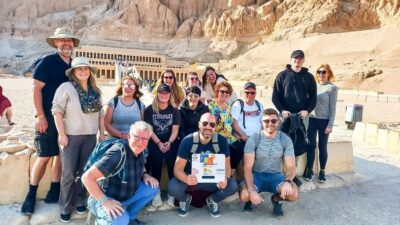
Luxor Valley of the Kings & Tutankhamun Tomb Trip
Read our review →
Small group Hurghada to Luxor, Valley of the Kings by Van
Read our review →
Valley of the Kings and Hatshepsut Temple Day Tour
Read our review →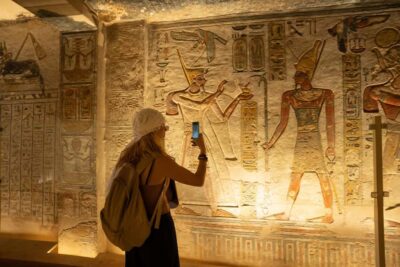
Luxor Tour with Valley of Kings, Karnak & Tut Tomb
Read our review →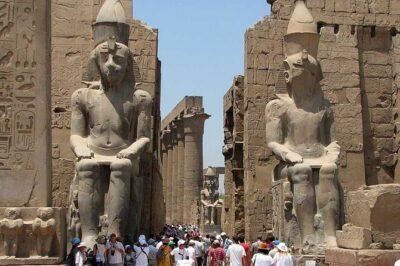
Valley of Kings, Hatchepsut Temple ,Karnak & Luxor-DayTour
Read our review →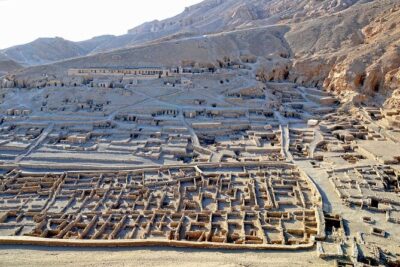
Full Day Tour of Luxor West Bank Temples and Tombs (Private)
Read our review →
Small Group Excursion to Luxor Valley of the Kings from Hurghada
Read our review →Browse the lists this tour appears in