
Reviewed · KHAN EL-KHALILI & OLD CAIRO TOURS
Private Tour: Coptic Cairo, The Hanging Church, Abu Serga, Ben Ezra
Old Cairo tells stories you can see. I love the way the Hanging Church sits above a Roman water gate, and I love that your Egyptologist guide turns the icons and inscriptions into clear, human stories. You get a focused 3-hour loop with hotel pickup, key Coptic sites, and a final stop at the Coptic Museum.
This is a great way to understand Cairo’s Coptic Christian community in a short morning. You’ll head into Old Cairo, see the Hanging Church, go on to Abu Serga and the Ben Ezra Synagogue, and finish with the museum’s major collection.
One heads-up: access and timing can shift at Ben Ezra if there’s construction, and sometimes the plan is adjusted at the last minute.
In This Review
- Key highlights to pay attention to
- Old Cairo, Coptic churches, and why this loop works
- Timing, pickup, and what 3 hours really means
- The Hanging Church above the Roman water gate
- St George Church and the round-church detail people miss
- Abu Serga, columns, icons, and the Holy Family story
- Ben Ezra Synagogue, old layers, and possible renovation
- Coptic Museum inside Babylon Fort, what to focus on in 30 minutes
- Lunch and the papyrus institute pause
- Price and logistics: is $74.82 a fair deal?
- What you’ll learn, and what to ask your guide
- Tips so your photos, clothing, and pace all work
- Should you book this private Coptic Cairo tour?
- FAQ
- What is the duration of the private tour?
- What time does the tour start?
- Is hotel pickup included?
- Is this tour private?
- Which main sites are visited?
- Is the Coptic Museum ticket included?
- Is lunch included?
- Is there any papyrus-related visit?
- Are admission tickets for Ben Ezra included?
- Can I get a refund if my plans change?
Key highlights to pay attention to
- Hanging Church: possibly the oldest church in Egypt, dedicated to the Virgin Mary, built above the Roman water gate
- Abu Serga: 5th-century Coptic church tied to the Holy Family story, with 24 marble columns and 12th-century icons
- Ben Ezra Synagogue: one of Egypt’s oldest synagogues, in a shady garden, with renovation work at times
- Coptic Museum in Babylon Fort: big collection in a small time window, including icons and books
- Private guide attention: you can ask questions and shape the pace to what you care about
Old Cairo, Coptic churches, and why this loop works
Coptic Cairo is the part of Cairo where you stop thinking in eras and start thinking in layers. One block can hold Roman walls, early Christian worship, later restorations, and then today’s community all at once. In just 3 hours, this private tour gives you a tight path through that layering.
What I like is that it is not only about one famous church. You get a chain: the Hanging Church, then Abu Serga, then a look at Ben Ezra before you close at the Coptic Museum. That order matters because the museum helps you place what you saw on your feet, not just admire it as decoration.
You’ll travel by air-conditioned minivan from your hotel. Start time is 9:00 am, so you dodge a lot of the worst heat and crowding. The tour is private, so you are not stuck with a loud group hijacking the pace while your guide tries to explain symbols meant for slow looking.
More Old Cairo walks:
- Cairo: Egyptian Museum, Citadel, and Old Cairo Guided Tour
★ 4.7 · 853 reviews - Cairo Citadel, Old Cairo and Khan El Khalili: Private Tour
★ 4.6 · 741 reviews - Old Cairo: Full-Day Islamic and Coptic Cairo Tour with Lunch
★ 4.6 · 688 reviews
Timing, pickup, and what 3 hours really means
This is a 3-hour private tour with a hotel pickup and a hotel drop-off. In practice, that means you are on a schedule, even though you have a private guide. The big risk with a short tour is that each stop can feel rushed if you try to do everything at once.
The itinerary is built around short, high-value visits. The Hanging Church and the St George area take the opening stretch, Abu Serga is a focused stop, Ben Ezra is timed, and then you get a final museum visit. The museum is listed for about 30 minutes, so you should go in with a plan: pick a few rooms or themes to look for, and let your guide point out what is most worth your time.
One more practical note: you can tailor the commentary if you have specific interests. If you care more about theology, architecture, or art, tell your guide early. On private tours, that small conversation can change the whole experience.
The Hanging Church above the Roman water gate
The Hanging Church, also called St Virgin Mary’s Church, is the kind of place you understand fast, even if your brain needs time to process the age. It is built into the walls of a Roman fortress, above what was a water gate. That simple fact gives the building a weird, compelling gravity. You’re not just looking at an old church, you’re looking at a church fused to older city infrastructure.
Dedicated to the Virgin Mary, the church is often described as possibly the oldest Christian church in Egypt. What you’ll notice once you’re inside is the interior layout and its symbolism, including screens, a marble pulpit, and icons that guide your eye. Your guide should connect what you see to how early Christians lived with faith in everyday space, not just in grand settings.
I also like that the Hanging Church stop is paired with the St George church and monastery next. It keeps the morning moving through Coptic sacred architecture instead of treating each site like a separate postcard.
St George Church and the round-church detail people miss
After the Hanging Church, you’ll visit the Monastery and Church of St George. The church itself is from the early 20th century, dated to 1909, but there has been a church dedicated to the Martyr since the 10th century in this area. That timeline helps you understand why these sites feel continuous, even when the visible building changes.
The standout feature here is shape. It’s described as the only round church in Egypt, and the wider context includes the fact that it is one of the few remaining circular churches in the Middle East. Circular sacred spaces can feel different from the usual rectangular church layout. In a short tour, this is a quick way to see how form can affect worship and atmosphere.
If you’re the kind of visitor who likes to compare design choices, this stop gives you a contrast point. Hanging Church feels built into older fortress walls. St George feels more deliberately shaped around a unique plan. Both help you read Coptic Cairo as architecture with a point.
Other Cairo options on the table
- Cairo: Pyramids & Great Sphinx Private Tour with Camel Ride
★ 4.9 · 6,335 reviews - Tour to Giza Pyramids and The Egyptian Museum
★ 5.0 · 6,016 reviews - VIP All inclusive Best of the best Giza Pyramids,Sakkara,Memphis
★ 5.0 · 3,164 reviews - From Cairo: Pyramids of Giza, Sphinx, Saqqara & Memphis Tour
★ 4.7 · 3,110 reviews
Abu Serga, columns, icons, and the Holy Family story
Next comes Abu Serga, a 5th-century Coptic church. This is the stop that pulls many people in immediately because of the connection to the Holy Family story, tied to the belief that the Holy Family rested here when fleeing from Israel, during the reign of King Herod.
In the courtyard, you’ll see 24 marble columns lining the central space. The number is striking, but what matters for you as a visitor is the effect it creates. It frames sightlines and turns a courtyard into a kind of outdoor sacred room. Then you move to the interior wall icons.
You’ll also get a look at 12th-century icons on the walls. Even if you cannot read everything, icons in places like this often function like a visual lesson plan. A good guide will explain not only what the icons depict, but how the community used them for memory, teaching, and identity.
One small practical consideration: the courtyard and interior can mean a mix of bright light and shaded stone. Wear something comfortable and plan for your eyes to adjust. Your guide will likely slow down if you ask to look longer.
Ben Ezra Synagogue, old layers, and possible renovation
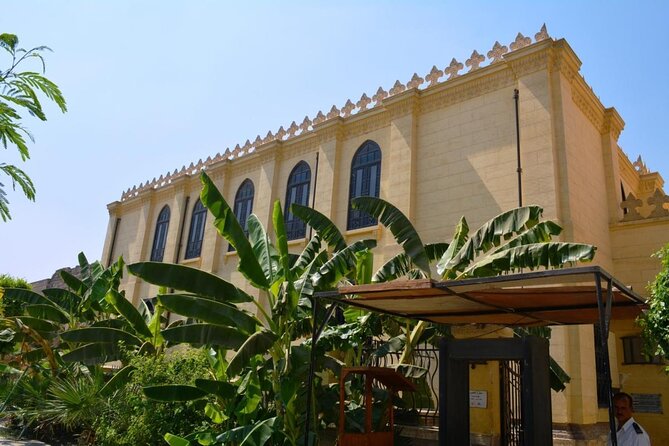
Ben Ezra Synagogue is in a shady garden, and it is one of the oldest synagogues in Egypt. Here’s the twist that makes the stop more than a quick photo moment: the synagogue is on the site of a 4th-century Christian church.
In more recent decades, the building was damaged during conflict and was then renovated. The tour description also notes that there can be construction inside for a limited time, which is important for your expectations. If access is limited, your guide should still give you the main context, but you might not see every area.
Also, be flexible. If a part of Ben Ezra is closed on the day you go, the itinerary may shift so you still get a strong Coptic Cairo experience. One site swap that comes up in practice is that St George is sometimes visited instead when Ben Ezra access is not possible.
Coptic Museum inside Babylon Fort, what to focus on in 30 minutes
The final major stop is the Coptic Museum, located in one of the oldest areas of Coptic Cairo, inside the precinct of the Babylon Fort. The museum covers more than 8,000 square meters and is described as holding almost 16,000 objects linked to the Copts of Egypt.
Here is the challenge you should plan for: 30 minutes is not enough to see everything. So instead of trying to absorb the entire museum, use your earlier church stops as your mental “shopping list.” Ask your guide to point out items that connect directly to what you saw at the Hanging Church, Abu Serga, or Ben Ezra.
You can expect to see icons and books, and those help you understand how Coptic worship and identity traveled through time. If you care about art, watch how styles change from one period to the next. If you care about faith, ask your guide how these objects functioned in daily religious life.
This is also a value stop. Museum admission is included, and you end your tour with a place that turns architecture into context. Without this final stop, the morning can feel like a set of impressive buildings. With it, the buildings turn into a story.
Lunch and the papyrus institute pause
This tour includes lunch at an oriental restaurant. It’s a nice pressure release when you’re doing multiple religious sites in a morning. In Egypt, food breaks can also help you regain energy for the back half of the schedule.
After the museum, you may have an optional extra: a papyrus institute where artisans paint on papyrus. It’s a small moment, but it gives you a tactile connection between religion, art, and writing traditions. You might also have the chance to buy artwork if you want a portable memory.
If you do stop at the papyrus workshop, keep your time awareness. This part can be the difference between you feeling relaxed and you feeling hurried as you wrap up for the hotel drop-off.
Price and logistics: is $74.82 a fair deal?
At $74.82 per person, this tour can be good value if you want a private guide and hotel pickup. You’re not just paying for entry tickets. Your cost includes private transportation by air-conditioned minivans, the Egyptologist guide, and admission at key stops like the Coptic Museum. Lunch is included too.
It’s also booked in advance quite often, with an average booking window of about 41 days. That matters because Cairo schedules can be flexible, and the better your timing, the more likely you get the smooth morning you want.
Two practical cost notes to keep in mind:
- There’s a supplement for a Russian-language guide listed as 800 E.L.
- Pickup region supplements may apply depending on where you stay, including areas like 6th of October, New Capital region, or Settlement.
If you’re traveling with someone and want a quieter, less crowded route, the private format is the big quality driver. If you prefer a strict checklist with no swapping, you should be ready for the one-day reality that places like Ben Ezra can have renovation or limited access.
What you’ll learn, and what to ask your guide
The best part of a private tour like this is that the guide can connect objects to meaning. A strong guide does not just recite dates. They explain why a column count matters, why an icon style looks the way it does, and what it meant for the people who used the church long before you arrived.
Guides who have led this route are often praised for being energetic and able to answer questions clearly. Names that come up include Muhammad, Timur, Tarek, Rhonda, Amgad, Hussein, and Fouad Salah. If your guide is one of the talkers, feel free to steer them. Ask questions like:
- How do these Coptic churches relate to earlier Roman layers in the fortress areas?
- What does Abu Serga’s icon program teach about the community’s faith?
- Why is the Ben Ezra site important since it includes a Christian layer before the synagogue?
You might also want to ask about photo rules on the day. One practical point you may run into in church and museum spaces is that camera use can sometimes require a fee.
Tips so your photos, clothing, and pace all work
Coptic churches and museum spaces usually expect respectful dress. I recommend you dress modestly and comfortably. You want freedom to look closely, and you also want fewer interruptions at entrances.
Second, plan your phone and camera battery. You’ll see a lot of carved stone, icon faces, and indoor lighting that can be tricky for photos. If you care about images, ask your guide early where the best light is, because the best angles are not always the obvious ones.
Third, don’t over-pack your attention. This is a short tour, so pick your priorities. If you love art, spend extra time with icons and wall details. If you love architecture, focus on how each site uses its space. If you love faith and story, ask your guide to connect the Hanging Church and Abu Serga to the traditions people carry forward.
Should you book this private Coptic Cairo tour?
If you want a concentrated introduction to Coptic Cairo, I think this tour is a solid choice. The mix of the Hanging Church, Abu Serga, Ben Ezra, and the Coptic Museum gives you both the “wow buildings” and the “why it matters” context, without needing a full day.
Book it if:
- You like private guides and want your questions answered.
- You want a short morning plan that still feels structured.
- You want to connect church art to museum objects.
Skip it or go in with flexible expectations if:
- You are the type who needs every single listed interior area with no substitutions, since limited access or renovation can affect stops.
- You’re worried about a tighter schedule, because 3 hours means you should choose what to linger on.
FAQ
What is the duration of the private tour?
The tour is about 3 hours.
What time does the tour start?
The start time is 9:00 am.
Is hotel pickup included?
Yes, pickup is offered from your Cairo or Giza hotel by air-conditioned minivan, and you also get a hotel drop-off.
Is this tour private?
Yes, it is private, with only your group participating.
Which main sites are visited?
The tour includes the Hanging Church, the Monastery and Church of St George, Abu Serga, Ben Ezra Synagogue, and ends at the Coptic Museum.
Is the Coptic Museum ticket included?
Yes, admission to the Coptic Museum is included.
Is lunch included?
Yes, lunch at an oriental restaurant is included.
Is there any papyrus-related visit?
Yes, there is an opportunity to visit a papyrus institute to see artisans paint on papyrus, and you may be able to purchase artwork.
Are admission tickets for Ben Ezra included?
Yes, admission to Ben Ezra Synagogue is included.
Can I get a refund if my plans change?
Yes, cancellation is free up to 24 hours in advance for a full refund. If you cancel less than 24 hours before the start time, the amount paid is not refunded.
Newly added near Cairo
- Full Day Trip from Cairo to Luxor★ 5.0 · 16 reviews
- Private half Day Tour to the Great 3 Pyramids of Egypt★ 5.0 · 15 reviews
- Private Guided Day Tour to Luxor from Cairo by Plane★ 4.5 · 11 reviews
- Private guide’s trip to Giza pyramids, Great sphinx valley temple★ 5.0 · 37 reviews
- Explore Pyramids & Great Egyptian Museum(gym)★ 5.0 · 12 reviews
- White desert camping and Baharya oasis overnight from Cairo★ 4.5 · 12 reviews
- Full-Day Private Tour to Giza Pyramids, Sphinx, Memphis & Saqqara★ 5.0 · 106 reviews
- Unique Tour to The Grand Egyptian Museum and 12 main galleries★ 4.0 · 38 reviews
Khan el-Khalili & Old Cairo Tours, compared.
Egyptian Museum, Citadel, and Old Cairo Guided Tour
Read our review →
Cairo Citadel, Old Cairo and Khan El Khalili: Private Tour
Read our review →
Full-Day Islamic and Coptic Cairo Tour with Lunch
Read our review →
Old Cairo Guided Walk Tour: History, Culture & Street Bites
Read our review →
Local Markets & Khan el Khalili Private Shopping Tour
Read our review →
Museum of Egyptian Civilization, Citadel & Old Cairo Tour
Read our review →
4-hours private Tour Islamic Mosque,Coptic Cairo &Khan el-Khalili
Read our review →
Cairo VIP Guided Tour to Khan El-Khalili Market with Lunch
Read our review →Browse the lists this tour appears in